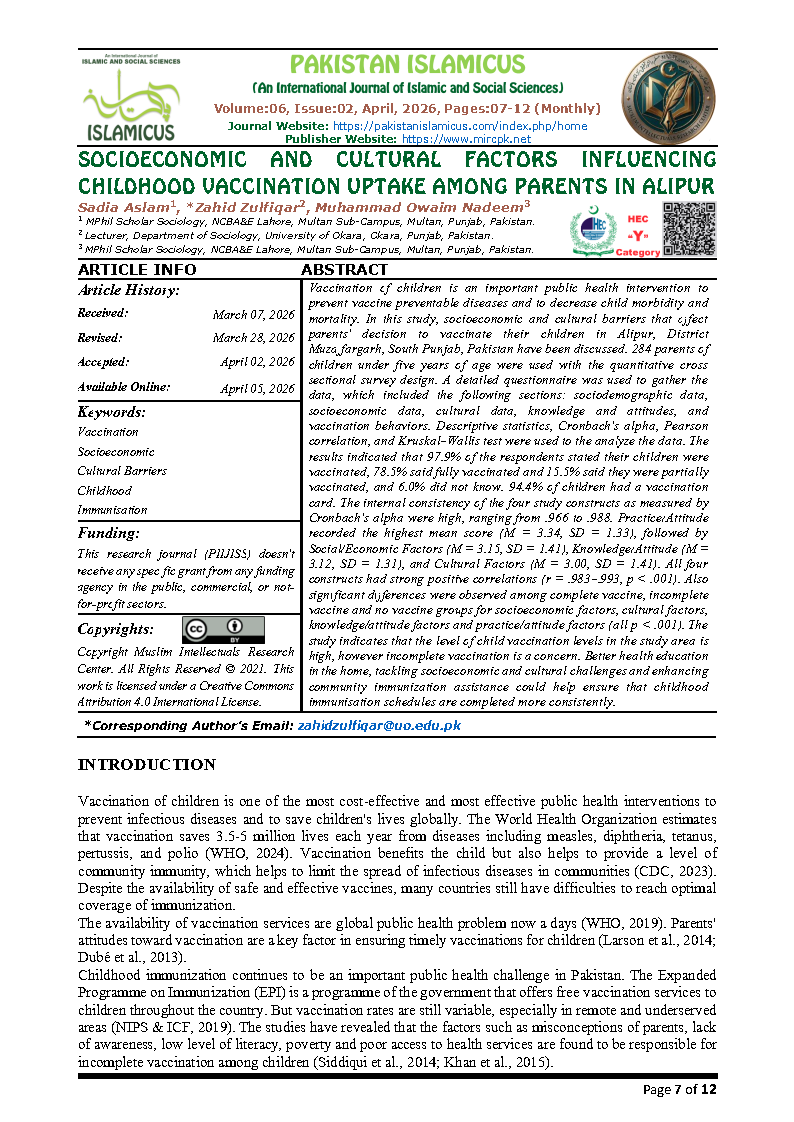
SOCIOECONOMIC AND CULTURAL FACTORS INFLUENCING CHILDHOOD VACCINATION UPTAKE AMONG PARENTS IN ALIPUR
Keywords:
Vaccination, Socioeconomic, Cultural Barriers, Childhood, ImmunizationAbstract
Vaccination of children is an important public health intervention to prevent vaccine preventable diseases and to decrease child morbidity and mortality. In this study, socioeconomic and cultural barriers that affect parents' decision to vaccinate their children in Alipur, District Muzaffargarh, South Punjab, Pakistan have been discussed. 284 parents of children under five years of age were used with the quantitative cross sectional survey design. A detailed questionnaire was used to gather the data, which included the following sections: sociodemographic data, socioeconomic data, cultural data, knowledge and attitudes, and vaccination behaviors. Descriptive statistics, Cronbach's alpha, Pearson correlation, and Kruskal–Wallis test were used to the analyze the data. The results indicated that 97.9% of the respondents stated their children were vaccinated, 78.5% said fully vaccinated and 15.5% said they were partially vaccinated, and 6.0% did not know. 94.4% of children had a vaccination card. The internal consistency of the four study constructs as measured by Cronbach's alpha were high, ranging from .966 to .988. Practice/Attitude recorded the highest mean score (M = 3.34, SD = 1.33), followed by Social/Economic Factors (M = 3.15, SD = 1.41), Knowledge/Attitude (M = 3.12, SD = 1.31), and Cultural Factors (M = 3.00, SD = 1.41). All four constructs had strong positive correlations (r = .983–.993, p < .001). Also significant differences were observed among complete vaccine, incomplete vaccine and no vaccine groups for socioeconomic factors, cultural factors, knowledge/attitude factors and practice/attitude factors (all p < .001). The study indicates that the level of child vaccination levels in the study area is high, however incomplete vaccination is a concern. Better health education in the home, tackling socioeconomic and cultural challenges and enhancing community immunization assistance could help ensure that childhood immunisation schedules are completed more consistently.
Downloads
References
Akhter, N., et al. (2024). Trends in childhood vaccination in Pakistan and associated factors; 2006–2018. Vaccine, 42(8), 1955–1962. https://doi.org/10.1016/j.vaccine.2024.01.014
Ashfaq, J., Ullah, K., Khattak, F. A., Hakim, M., et al. (2026). Barriers and facilitators of childhood immunization: Sociodemographic and knowledge-related determinants among parents in rural and urban Khyber Pakhtunkhwa, Pakistan. Epidemiology and Infection, 154, e41.
Centers for Disease Control and Prevention. (2023). Vaccines and immunizations. CDC.
Dubé, E., Laberge, C., Guay, M., Bramadat, P., Roy, R., & Bettinger, J. A. (2013). Vaccine hesitancy: An overview. Human Vaccines & Immunotherapeutics, 9(8), 1763–1773. https://doi.org/10.4161/hv.24657
Khan, M. T., Zaheer, S., & Shafique, K. (2020). Decomposing socio-economic inequality in vaccination coverage among Pakistani children: A population-based cross-sectional study. Health & Social Care in the Community, 28(6), 2093–2101. https://doi.org/10.1111/hsc.13163
Khan, M. U., Ahmad, A., Aqeel, T., Salman, S., Ibrahim, Q., Idrees, J., & Khan, M. U. (2015). Knowledge, attitudes and perceptions towards polio immunization among residents of two highly affected regions of Pakistan. BMC Public Health, 15, 1100. https://doi.org/10.1186/s12889-015-2471-1
Larson, H. J., Jarrett, C., Eckersberger, E., Smith, D. M., & Paterson, P. (2014). Understanding vaccine hesitancy around vaccines and vaccination. Vaccine, 32(19), 2150–2159. https://doi.org/10.1016/j.vaccine.2014.01.081
Mumtaz, H., et al. (2021). Unveiling and addressing implementation barriers to routine immunization in the peri-urban slums of Karachi: A mixed-methods study. BMC Public Health, 21, Article 1822.
National Institute of Population Studies (NIPS), & ICF. (2019). Pakistan demographic and health survey 2017–18. Islamabad, Pakistan: NIPS and ICF.
Nisar, M. I., et al. (2023). Differential coverage for vaccines in the expanded program on immunization (EPI) among children in rural Pakistan. BMC Public Health, 23, Article 494.
Siddiqui, T. R., Nisar, N., Hassan, A., Hussain, S. S., & Ahmed, I. (2014). Assessment of knowledge, attitudes and practices regarding immunization among parents in Pakistan. Journal of Pakistan Medical Association, 64(9), 1010–1014.
World Health Organization. (2019). Ten threats to global health in 2019. Geneva, Switzerland: WHO.
World Health Organization. (2024). Immunization agenda 2030: A global strategy to leave no one behind. Geneva, Switzerland: WHO.
Downloads
Published
Issue
Section
License
Copyright (c) 2026 PAKISTAN ISLAMICUS (An International Journal of Islamic & Social Sciences)

This work is licensed under a Creative Commons Attribution 4.0 International License.
This work is licensed under a Creative Commons Attribution 4.0 International License.