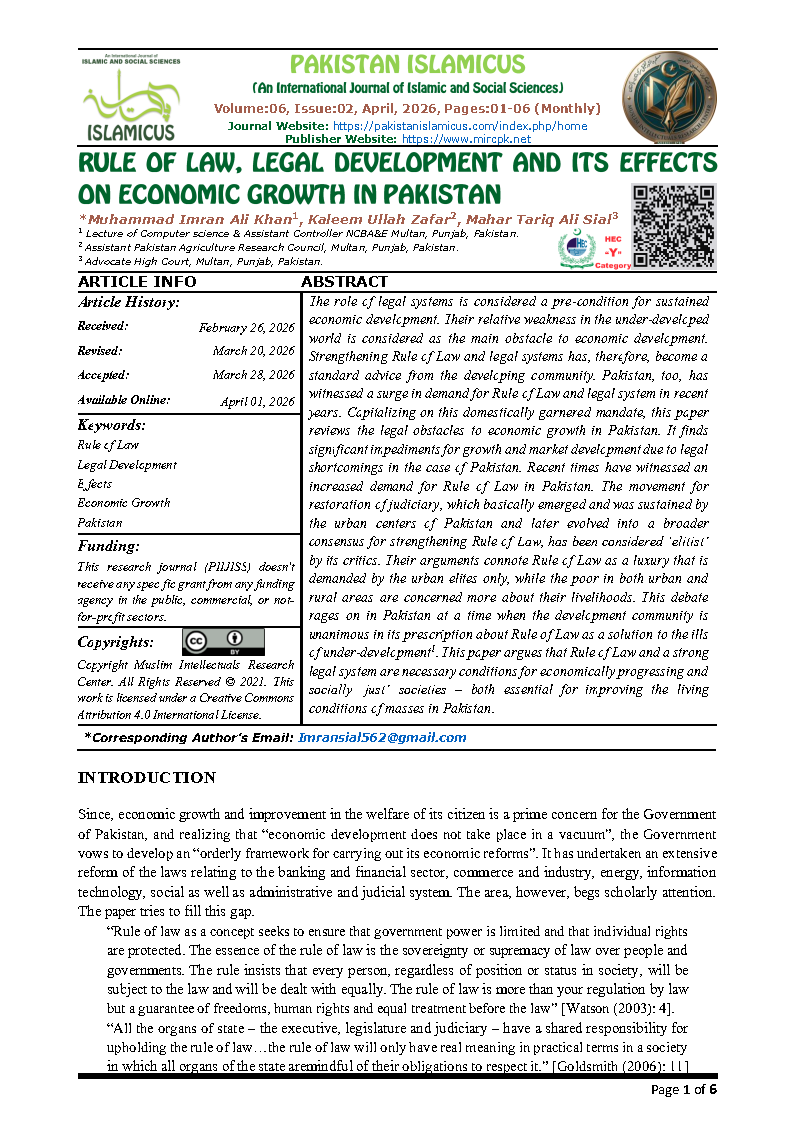
RULE OF LAW, LEGAL DEVELOPMENT AND ITS EFFECTS ON ECONOMIC GROWTH IN PAKISTAN
Keywords:
Rule of Law, Legal Development, Effects, Economic Growth, PakistanAbstract
The role of legal systems is considered a pre-condition for sustained economic development. Their relative weakness in the under-developed world is considered as the main obstacle to economic development. Strengthening Rule of Law and legal systems has, therefore, become a standard advice from the developing community. Pakistan, too, has witnessed a surge in demand for Rule of Law and legal system in recent years. Capitalizing on this domestically garnered mandate, this paper reviews the legal obstacles to economic growth in Pakistan. It finds significant impediments for growth and market development due to legal shortcomings in the case of Pakistan. Recent times have witnessed an increased demand for Rule of Law in Pakistan. The movement for restoration of judiciary, which basically emerged and was sustained by the urban centers of Pakistan and later evolved into a broader consensus for strengthening Rule of Law, has been considered ‘elitist’ by its critics. Their arguments connote Rule of Law as a luxury that is demanded by the urban elites only, while the poor in both urban and rural areas are concerned more about their livelihoods. This debate rages on in Pakistan at a time when the development community is unanimous in its prescription about Rule of Law as a solution to the ills of under-development1. This paper argues that Rule of Law and a strong legal system are necessary conditions for economically progressing and socially ‘just’ societies – both essential for improving the living conditions of masses in Pakistan.
Downloads
References
Acemoglu, D., S. Johnson, and J. A. Robinson (2001) The Colonial Origins of Comparative Development: An Empirical Investigation. American Economic Review 91: December, 1369–1401.
Acemoglu, D., S. Johnson, and J. A. Robinson (2002) Reversal of Fortune: Geography and Institutions in the Making of the Modern World Income Distribution. Quarterly Journal of Economics 117: November, 1231–1294.
Acemoglu, D. (2003) The Root Cause. Finance and Development. June, 27–30. Acemoglu, D., S. Johnson, and J. A. Robinson (2005a) Institutions as the Fundamental Cause of Long-Run Growth. In P. Aghion and S. Durlauf (eds.) Handbook of Economic Growth. North Holland.
Acemoglu, D., S. Johnson, and J. A. Robinson (2005b) The Rise of Europe: Atlantic Trade, Institutional Change and Economic Growth. American Economic Review 95: June, 546–579.
Ali, M. A and W.M Crain (2002) Institutional Distortions, Economic Freedom, and Growth. Cato Journal, Vol. 21, No. 3: Winter, 415-426.
Ali, M. A. and H. S. Isse (2003) Determinants of Economic Corruption: A Cross-country Comparison. Cato Journal, Vol. 22, No. 3: Winter, 449-466.
Alon, I. and G. Chase (2005) Religious Freedom and Economic Prosperity. Cato Journal, Vol. 25, No. 2: Spring/Summer, 399-406.
Armytage, L. (2003) Pakistan’s Law and Justice Sector Reform Experience – Some Lessons. Paper presented at the 13th Commonwealth Law Conference (14 April 2003). Melbourne.
Asian Development Bank (2004) Law and Policy Reform at the Asian Development Bank.
Asian Development Bank, Manila, Philippines.
Asia-Pacific Economic Cooperation (2007) APEC Economic Policy Report. APEC Secretariat, Singapore
Berggren,N. (2003) The Benefits of Economic Freedom A Survey The Independent Review, VIII (2): Fall, pp. 193– 211.
Blue, R., R. Hoffman and L. A. Berg (2008) Pakistan Rule of Law Assessment – Final Report. Prepared for the USAID/Pakistan by Management System International. Washington D C.
Buscaglia, E. (2000) Law and Economics of Development in Encyclopedia of Law and Economics. Edward Elgar and University of Ghent. Downloaded from: http://encyclo.findlaw.com/0580book.pdf.
Carothers, T. (1998) The Rule of Law Revival. Foreign Affairs, 77 (2): March/April, 95- 106.
Chaudhry, I. M. (2007) Keynote Address of Mr. Justice Iftikhar Muhammad Chaudhry, Honorable Chief Justice of Pakistan. Islamabad. Downloaded from: http://www.ljcp.gov.pk/njc/
Cheema, A. (2003) Corporate Governance in Pakistan: Issues and Concerns. The NIPA Journal, 8(2): June, 7-19.
Cheema, A., F. Bari, and O. Siddique (2003). Corporate Governance in Pakistan: Ownership, Control and the Law in F. Sobhan and EW. Werner (eds.) A Comparative Analysis of Corporate Governance in South Asia. Bangladesh Enterprise Institute, Dhaka.
Cole, J. H. (2003) The Contribution of Economic Freedom to World Economic Growth, 1980–99. Cato Journal, Vol. 23, No. 2: Fall, 189-198.
Downloads
Published
Issue
Section
License
Copyright (c) 2026 PAKISTAN ISLAMICUS (An International Journal of Islamic & Social Sciences)

This work is licensed under a Creative Commons Attribution 4.0 International License.
This work is licensed under a Creative Commons Attribution 4.0 International License.