تعزیر کے احکام واثرات: شرعی و وضعی قوانین کا تقابلی جائزہ
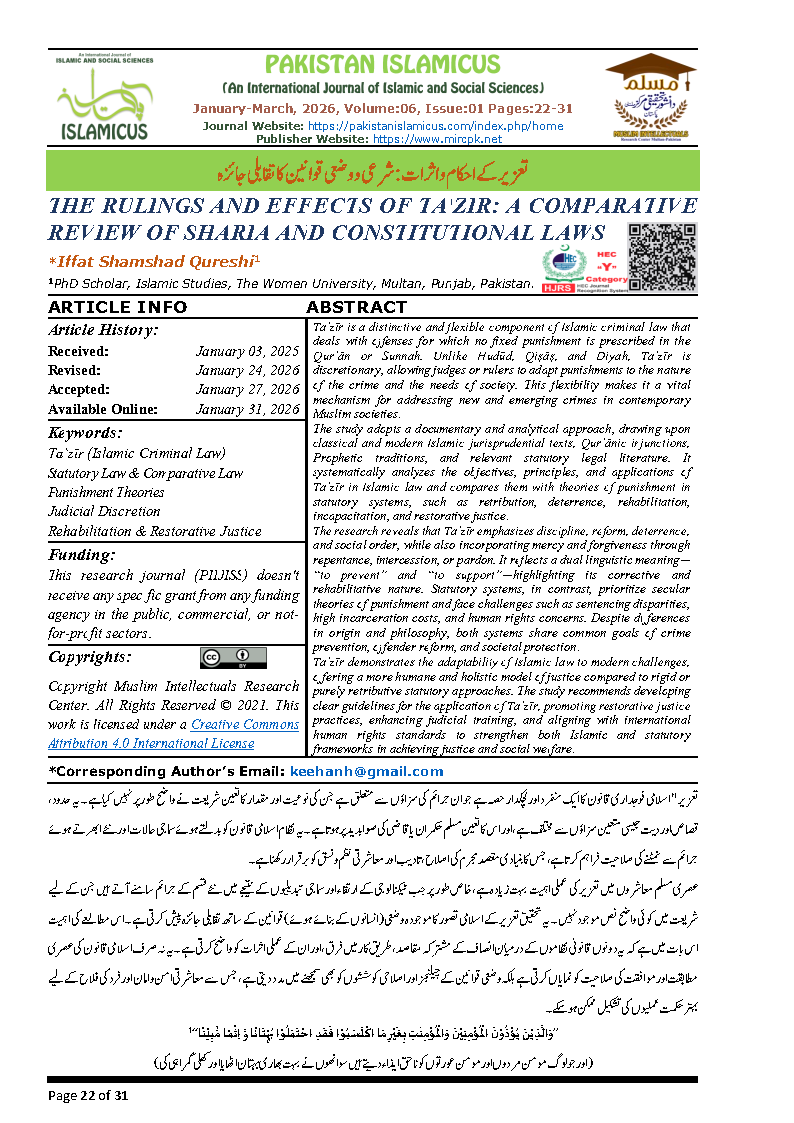
THE RULINGS AND EFFECTS OF TA'ZIR: A COMPARATIVE REVIEW OF SHARIA AND CONSTITUTIONAL LAWS
Keywords:
Taʿzīr (Islamic Criminal Law), Statutory Law & Comparative Law, Punishment Theories, Judicial Discretion, Rehabilitation & Restorative JusticeAbstract
Taʿzīr is a distinctive and flexible component of Islamic criminal law that deals with offenses for which no fixed punishment is prescribed in the Qurʾān or Sunnah. Unlike Hudūd, Qiṣāṣ, and Diyah, Taʿzīr is discretionary, allowing judges or rulers to adapt punishments to the nature of the crime and the needs of society. This flexibility makes it a vital mechanism for addressing new and emerging crimes in contemporary Muslim societies.
The study adopts a documentary and analytical approach, drawing upon classical and modern Islamic jurisprudential texts, Qurʾānic injunctions, Prophetic traditions, and relevant statutory legal literature. It systematically analyzes the objectives, principles, and applications of Taʿzīr in Islamic law and compares them with theories of punishment in statutory systems, such as retribution, deterrence, rehabilitation, incapacitation, and restorative justice.
The research reveals that Taʿzīr emphasizes discipline, reform, deterrence, and social order, while also incorporating mercy and forgiveness through repentance, intercession, or pardon. It reflects a dual linguistic meaning—“to prevent” and “to support”—highlighting its corrective and rehabilitative nature. Statutory systems, in contrast, prioritize secular theories of punishment and face challenges such as sentencing disparities, high incarceration costs, and human rights concerns. Despite differences in origin and philosophy, both systems share common goals of crime prevention, offender reform, and societal protection
Taʿzīr demonstrates the adaptability of Islamic law to modern challenges, offering a more humane and holistic model of justice compared to rigid or purely retributive statutory approaches. The study recommends developing clear guidelines for the application of Taʿzīr, promoting restorative justice practices, enhancing judicial training, and aligning with international human rights standards to strengthen both Islamic and statutory frameworks in achieving justice and social welfare.
Downloads
References
al-Qurʾān, 33:58.
Ṣaḥīḥ al-Bukhārī, Kitāb al-Ḥudūd, Ḥadīth 6848.
Mawdūdī, Abū al-Aʿlā. Islām kā Niẓām-e-Zindagī. Bāb: Islāmī Niẓām-e-ʿAdl, ṣ. 112. Lāhaur: Idārah Tarjumān al-Qurʾān.
Rāghib. Mufradāt al-Qurʾān.
Ṣāliḥ bin Fawzān, Faḍīlat al-Shaykh, wa Muḥammad Aṣghar Ṣārim (Mutarjim). Fiqhī Aḥkām wa asāʾil. Majallah 1, ṣ. 434, Bāb 15.
Ṣāliḥ bin Fawzān, Faḍīlat al-Shaykh, wa Muḥammad Aṣghar Ṣārim (Mutarjim). Fiqhī Aḥkām wa asāʾil. Majallah 1, ṣ. 434, Bāb 15
Ṣāliḥ bin Fawzān, Faḍīlat al-Shaykh, wa Muḥammad Aṣghar Ṣārim (Mutarjim). Fiqhī Aḥkām wa asāʾil. Majallah 1, ṣ. 434, Bāb 15
Taʿzīr. Wikī Shīʿah. https://ur.wikishia.net/vies/%d8%AAY.%20D8%/B9%b2%DB%8C%d8%B1 (Accessed June 17, 2025).
Taʿzīr. Wikī Shīʿah. https://ur.wikishia.net/vies/%d8%AAY.%20D8%/B9%b2%DB%8C%d8%B1 (Accessed June 17, 2025).
Kāsānī, ʿAlāʾ al-Dīn. al-Badāʾiʿ al-Ṣanāʾiʿ (Mutarjim: Dr. Maḥmūd al-Ḥasan ʿĀrif). Markaz Taḥqīq Diyāl Singh Trust Library, Nisbat Road, Lāhaur, j. 7, ṣ. 64.
Anas, Imām Mālik bin Anas. al-Mudawwanah al-Kubrā. Dār al-Kutub al-ʿIlmiyyah, Bayrūt, Lubnān, j. 4, ṣ. 437.
Shāfiʿī, Imām Muḥammad Idrīs Shāfiʿī. Kitāb al-Umm. Bayt al-Afkār al-Dawliyyah, j. 6, ṣ. 150.
Ibn Qudāmah, Imām. al-Mughnī. Maktabah al-Qāhirah, j. 109, ṣ. 330.
Amn Muʿāsharah aur Sazāʾōn kā Islāmī Taṣawwur. Express Urdu. Express.pk. (Accessed June 17, 2025).
Amn Muʿāsharah aur Sazāʾōn kā Islāmī Taṣawwur. Express Urdu. Express.pk. (Accessed June 17, 2025).
al-Qurʾān, 2:229.
Qiṣāṣ, Taʿzīr wa Ḥadd Chīst? Khabar Guzārī Mīzān. (Accessed June 17, 2025).
Qiṣāṣ, Taʿzīr wa Ḥadd Chīst? Khabar Guzārī Mīzān. (Accessed June 17, 2025).
Qiṣāṣ, Taʿzīr wa Ḥadd Chīst? Khabar Guzārī Mīzān. (Accessed June 17, 2025), Taʿzīr. Wikī Shīʿah.
Qiṣāṣ, Taʿzīr wa Ḥadd Chīst? Khabar Guzārī Mīzān. (Accessed June 17, 2025), Amn Muʿāsharah aur Sazāʾōn kā Islāmī Taṣawwur.
Qiṣāṣ, Taʿzīr wa Ḥadd Chīst? Khabar Guzārī Mīzān. (Accessed June 17, 2025), Amn Muʿāsharah aur Sazāʾōn kā Islāmī Taṣawwur.
Qiṣāṣ, Taʿzīr wa Ḥadd Chīst? Khabar Guzārī Mīzān. (Accessed June 17, 2025), Amn Muʿāsharah aur Sazāʾōn kā Islāmī Taṣawwur, Taʿzīr. Wikī Shīʿah.
Qiṣāṣ, Taʿzīr wa Ḥadd Chīst? Khabar Guzārī Mīzān. (Accessed June 17, 2025), Amn Muʿāsharah aur Sazāʾōn kā Islāmī Taṣawwur, Taʿzīr. Wikī Shīʿah.
Qiṣāṣ, Taʿzīr wa Ḥadd Chīst? Khabar Guzārī Mīzān. (Accessed June 17, 2025), Taʿzīr. Wikī Shīʿah, Amn Muʿāsharah aur Sazāʾōn kā Islāmī Taṣawwur.
Theories of Punishment. Sahnā Māhūrā, 2023. https://blog.Uplodess.in/theories-of-punishment
ʿAdālatī Niẓām kā Maqṣad Nah Sirf Tanāzuʿāt …
Tīn Nayē Fawjdārī Qawānīn kē Kāmyāb …………
ʿAbd al-Ḥafīẓ, Chaudhrī. Islāmī Ḥudūd wa Taʿzīrāt (Maḍmūn). Muḥaddith Magazine, January 1998.
ʿAbd al-Ḥafīẓ, Chaudhrī. Islāmī Ḥudūd wa Taʿzīrāt (Maḍmūn). Muḥaddith Magazine, January 1998, ʿAdālatī Niẓām kā Maqṣad Nah Sirf Tanāzuʿāt ……………….
ʿAbd al-Ḥafīẓ, Chaudhrī. Islāmī Ḥudūd wa Taʿzīrāt (Maḍmūn). Muḥaddith Magazine, January 1998, ʿAdālatī Niẓām kā Maqṣad Nah Sirf Tanāzuʿāt, Theories of Punishment, 2023.
Pākistān Mēn Siyāsatdānōn ko ʿAdālatī Sazāʾēn aur Un kē Atharāt. (Accessed June, 2025).
Pākistān Mēn Siyāsatdānōn ko ʿAdālatī Sazāʾēn aur Un kē Atharāt. (Accessed June, 2025), Fiqhī Aḥkām wa Masāʾil. Majallah 1 (Ṣāliḥ bin Fawzān).
Pākistān Mēn Siyāsatdānōn ko ʿAdālatī Sazāʾēn aur Un kē Atharāt. (Accessed June, 2025), Fiqhī Aḥkām wa Masāʾil. Majallah 1 (Ṣāliḥ bin Fawzān), ʿAbd al-Ḥafīẓ Chaudhrī, Islāmī Ḥudūd wa Taʿzīrāt.
Pākistān Mēn Siyāsatdānōn ko ʿAdālatī Sazāʾēn aur Un kē Atharāt. (Accessed June, 2025), Fiqhī Aḥkām wa Masāʾil. Majallah 1 (Ṣāliḥ bin Fawzān), ʿAbd al-Ḥafīẓ Chaudhrī, Islāmī Ḥudūd wa Taʿzīrāt, Amn Muʿāsharah aur Sazāʾōn kā Islāmī Taṣawwur, Express Urdu.
Āp kē Mujrimānah Record ko Seal Karnā. New York State Attorney General. June 17, 2025.
Taʿzīr. Āzād Dāʾirah al-Maʿārif. Wikipedia.
Taʿzīr. Āzād Dāʾirah al-Maʿārif. Wikipedia, Ṣāliḥ bin Fawzān, Fiqhī Aḥkām wa Masāʾil.
Ṣāliḥ bin Fawzān, Fiqhī Aḥkām wa Masāʾil, Taʿzīr. Āzād Dāʾirah al-Maʿārif. Wikipedia.
Ṣāliḥ bin Fawzān, Fiqhī Aḥkām wa Masāʾil, Taʿzīr. Āzād Dāʾirah al-Maʿārif. Wikipedia, ʿAdālatī Niẓām kā Maqṣad Nah Sirf Tanāzuʿāt ko Ḥal Karnā Hai.
Downloads
Published
Issue
Section
License
Copyright (c) 2026 PAKISTAN ISLAMICUS (An International Journal of Islamic & Social Sciences)

This work is licensed under a Creative Commons Attribution 4.0 International License.
This work is licensed under a Creative Commons Attribution 4.0 International License.