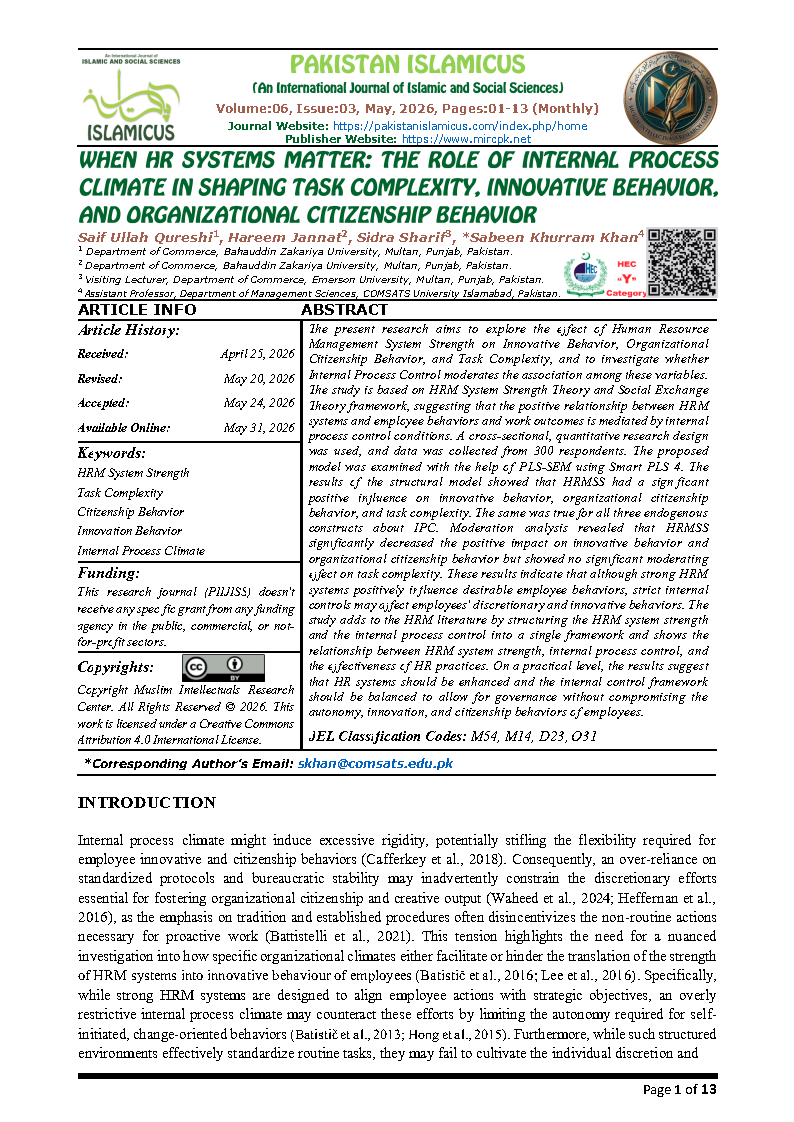
WHEN HR SYSTEMS MATTER: THE ROLE OF INTERNAL PROCESS CLIMATE IN SHAPING TASK COMPLEXITY, INNOVATIVE BEHAVIOR, AND ORGANIZATIONAL CITIZENSHIP BEHAVIOR
Keywords:
HRM System Strength, Task Complexity, Citizenship Behavior, Innovation Behavior, Internal Process ClimateAbstract
The present research aims to explore the effect of Human Resource Management System Strength on Innovative Behavior, Organizational Citizenship Behavior, and Task Complexity, and to investigate whether Internal Process Control moderates the association among these variables. The study is based on HRM System Strength Theory and Social Exchange Theory framework, suggesting that the positive relationship between HRM systems and employee behaviors and work outcomes is mediated by internal process control conditions. A cross-sectional, quantitative research design was used, and data was collected from 300 respondents. The proposed model was examined with the help of PLS-SEM using Smart PLS 4. The results of the structural model showed that HRMSS had a significant positive influence on innovative behavior, organizational citizenship behavior, and task complexity. The same was true for all three endogenous constructs about IPC. Moderation analysis revealed that HRMSS significantly decreased the positive impact on innovative behavior and organizational citizenship behavior but showed no significant moderating effect on task complexity. These results indicate that although strong HRM systems positively influence desirable employee behaviors, strict internal controls may affect employees' discretionary and innovative behaviors. The study adds to the HRM literature by structuring the HRM system strength and the internal process control into a single framework and shows the relationship between HRM system strength, internal process control, and the effectiveness of HR practices. On a practical level, the results suggest that HR systems should be enhanced and the internal control framework should be balanced to allow for governance without compromising the autonomy, innovation, and citizenship behaviors of employees.
JEL Classification Codes: M54, M14, D23, O31
Downloads
References
Adler, P. S., & Borys, B. (1996). Two types of bureaucracy: Enabling and coercive. Administrative Science Quarterly, 61–89.
Agarwal, P., & Farndale, E. (2017). High‐performance work systems and creativity implementation: the role of psychological capital and psychological safety. Human Resource Management Journal, 27(3), 440–458. https://doi.org/10.1111/1748-8583.12148
Agarwal, R., & Hoetker, G. (2007). A Faustian bargain? The growth of management and its relationship with related disciplines. Academy of Management Journal, 50(6), 1304–1322.
Ahmad, M., & Allen, M. (2015). High performance HRM and establishment performance in Pakistan: an empirical analysis. Employee Relations, 37(5), 506–524.
Ahmad, M., & Allen, M. (2015). High performance HRM and establishment performance in Pakistan: an empirical analysis. Employee Relations, 37(5), 506–524.
Ali, H., Li, M., & Qiu, X. (2022). Employee Engagement and Innovative Work Behavior Among Chinese Millennials: Mediating and Moderating Role of Work-Life Balance and Psychological Empowerment. Frontiers in Psychology, 13, 942580. https://doi.org/10.3389/fpsyg.2022.942580
Appelbaum, E. (2000). Manufacturing advantage: Why high-performance work systems pay off. Cornell University Press.
Appelbaum, E., Bailey, T., Berg, P., & Kalleberg, A. L. (2001). Do high performance work systems pay off?
Aryee, S., Walumbwa, F. O., Zhou, Q., & Hartnell, C. A. (2012). Transformational Leadership, Innovative Behavior, and Task Performance: Test of Mediation and Moderation Processes. Human Performance, 25(1), 1–25. https://doi.org/10.1080/08959285.2011.631648
Batistič, S., Černe, M., Kaše, R., & Župič, I. (2016). The role of organizational context in fostering employee proactive behavior: The interplay between HR system configurations and relational climates. Portsmouth Research Portal (University of Portsmouth), 34(5), 579–588. https://doi.org/10.1016/j.emj.2016.01.008
Batistič, S., Kaše, R., Černe, M., & Župič, I. (2013). The role of human resource systems in fostering proactive behaviors in companies: a multilevel analysis. https://puredev.port.ac.uk/en/publications/the-role-of-human-resource-systems-in-fostering-proactive-behavio
Battistelli, A., Odoardi, C., Cangialosi, N., Di Napoli, G., & Piccione, L. (2021). The role of image expectations in linking organizational climate and innovative work behaviour. European Journal of Innovation Management, 25(6), 204–222. https://doi.org/10.1108/ejim-01-2021-0044
Becker, B. E., Huselid, M. A., Becker, B. E., & Huselid, M. A. (1998). High performance work systems and firm performance: A synthesis of research and managerial implications. Research in Personnel and Human Resource Management.
Bedford, D. S., Bisbe, J., & Sweeney, B. (2019). Performance measurement systems as generators of cognitive conflict in ambidextrous firms. Accounting, Organizations and Society, 72, 21–37.
Blau, P. (2017). Exchange and power in social life. Routledge.
Boemelburg, R., Berger, S., Jansen, J. J. P., & Bruch, H. (2022). Regulatory focus climate, organizational structure, and employee ambidexterity: An interactive multilevel model. EUR Research Repository (Erasmus University Rotterdam), 62(5), 701–719. https://doi.org/10.1002/hrm.22155
Bowen, D. E., & Ostroff, C. (2004). Understanding HRM–firm performance linkages: The role of the “strength” of the HRM system. Academy of Management Review, 29(2), 203–221. https://doi.org/10.5465/amr.2004.12736076
Cafferkey, K., Heffernan, M., Harney, B., Dundon, T., & Townsend, K. (2018). Perceptions of HRM system strength and affective commitment: the role of human relations and internal process climate. The International Journal of Human Resource Management, 30(21), 3026–3048. https://doi.org/10.1080/09585192.2018.1448295
Černe, M., Hernaus, T., Dysvik, A., & Škerlavaj, M. (2017). The role of multilevel synergistic interplay among team mastery climate, knowledge hiding, and job characteristics in stimulating innovative work behavior. Human Resource Management Journal, 27(2), 281–299. https://doi.org/10.1111/1748-8583.12132
De Jong, J., & Den Hartog, D. (2010). Measuring innovative work behaviour. Creativity and Innovation Management, 19(1), 23–36.
Deci, E. L., & Ryan, R. M. (2012). Self-determination theory. Handbook of Theories of Social Psychology, 1(20), 416–436.
Deci, E. L., & Ryan, R. M. (2000). The what" and why" of goal pursuits: Human needs and the self-determination of behavior. Psychological Inquiry, 11(4), 227–268.
Goodhue, D., Lewis, W., & Thompson, R. (2006). PLS, small sample size, and statistical power in MIS research. Proceedings of the 39th Annual Hawaii International Conference on System Sciences (HICSS’06), 8, 202b–202b.
Hauff, S., Alewell, D., & Katrin Hansen, N. (2017). HRM system strength and HRM target achievement—toward a broader understanding of HRM processes. Human Resource Management, 56(5), 715–729. https://doi.org/10.1002/hrm.21798
Heffernan, M., Harney, B., Cafferkey, K., & Dundon, T. (2016). Exploring the HRM-performance relationship: the role of creativity climate and strategy. Employee Relations, 38(3), 438–462. https://doi.org/10.1108/er-06-2015-0110
Henseler, J., Ringle, C. M., & Sinkovics, R. R. (2009). The use of partial least squares path modeling in international marketing.
Hong, Y., Liao, H., Raub, S., & Han, J. H. (2015). What it takes to get proactive: An integrative multilevel model of the antecedents of personal initiative. Journal of Applied Psychology, 101(5), 687–701. https://doi.org/10.1037/apl0000064
Hurmelinna-Laukkanen, P., & Gomes, J. (2012). HRM system strength–HRM harnessed for innovation, appropriability and firm performance.
Jackson, S. E., & Schuler, R. S. (1992). HRM practices in service-based organizations: A role theory perspective. Advances in Services Marketing and Management, 1(1), 123–157.
Jiang, K., Lepak, D. P., Hu, J., & Baer, J. C. (2012). How does human resource management influence organizational outcomes? A meta-analytic investigation of mediating mechanisms. Academy of Management Journal, 55(6), 1264–1294. https://doi.org/10.5465/amj.2011.0088
Jiang, K., & Messersmith, J. (2018). On the shoulders of giants: A meta-review of strategic human resource management. The International Journal of Human Resource Management, 29(1), 6–33.
Khilji, S. E. (2004). Whither tradition? Evidence of generational differences in HR satisfaction from Pakistan. International Journal of Cross Cultural Management, 4(2), 141–156.
Kyndt, E., Dochy, F., Struyven, K., & Cascallar, E. (2011). The perception of workload and task complexity and its influence on students’ approaches to learning: A study in higher education. European Journal of Psychology of Education, 26(3), 393–415.
Lee, H. W., Pak, J., Kim, S., & Li, L. (2016). Effects of Human Resource Management Systems on Employee Proactivity and Group Innovation. Journal of Management, 45(2), 819–846. https://doi.org/10.1177/0149206316680029
Li, X., Frenkel, S. J., & Sanders, K. (2011). Strategic HRM as process: How HR system and organizational climate strength influence Chinese employee attitudes. The International Journal of Human Resource Management, 22(9), 1825–1842. https://doi.org/10.1080/09585192.2011.573965
Li, Y., & Abas, B. (2024). A Review of Research on Human Resource System Strength and Its Future Prospects. Journal of Humanities Arts and Social Science, 8(8), 1943–1949. https://doi.org/10.26855/jhass.2024.08.025
Mayer, D. M., Kuenzi, M., Greenbaum, R., Bardes, M., & Salvador, R. B. (2009). How low does ethical leadership flow? Test of a trickle-down model. Organizational Behavior and Human Decision Processes, 108(1), 1–13.
Mayer, D. M., Kuenzi, M., Greenbaum, R., Bardes, M., & Salvador, R. B. (2009). How low does ethical leadership flow? Test of a trickle-down model. Organizational Behavior and Human Decision Processes, 108(1), 1–13.
Nishii, L. H., & Paluch, R. M. (2018). Leaders as HR sensegivers: Four HR implementation behaviors that create strong HR systems. Human Resource Management Review, 28(3), 319–323.
Ogbonnaya, C., Daniels, K., Messersmith, J. G., & Rofcanın, Y. (2022). A Theory‐Based Analysis of Null Causality between HRM Practices and Outcomes: Evidence from Four‐Wave Longitudinal Data. Journal of Management Studies, 60(6), 1448–1484. https://doi.org/10.1111/joms.12881
Ostroff, C., & Bowen, D. E. (2015). Reflections on the 2014 Decade Award: Is There Strength in the Construct of HR System Strength? Academy of Management Review, 41(2), 196–214. https://doi.org/10.5465/amr.2015.0323
Parker, S. K., Ward, M. K., & Fisher, G. G. (2021). Can High-Quality Jobs Help Workers Learn New Tricks? A Multidisciplinary Review of Work Design for Cognition. ESpace (Curtin University), 15(2), 406–454. https://doi.org/10.5465/annals.2019.0057
Patterson, M. G., West, M. A., Shackleton, V. J., Dawson, J. F., Lawthom, R., Maitlis, S., Robinson, D. L., & Wallace, A. M. (2005). Validating the organizational climate measure: links to managerial practices, productivity and innovation. Journal of Organizational Behavior, 26(4), 379–408.
Pundt, A. (2015). The relationship between humorous leadership and innovative behavior. Journal of Managerial Psychology, 30(8), 878–893.
Rabl, T., Jayasinghe, M., Gerhart, B., & Kühlmann, T. M. (2014). A meta-analysis of country differences in the high-performance work system–business performance relationship: The roles of national culture and managerial discretion. Journal of Applied Psychology, 99(6), 1011.
Raub, S. (2008). Does bureaucracy kill individual initiative? The impact of structure on organizational citizenship behavior in the hospitality industry. International Journal of Hospitality Management, 27(2), 179–186.
Russo, S. Dello, Mascia, D., & Morandi, F. (2016). Individual perceptions of HR practices, HRM strength and appropriateness of care: a meso, multilevel approach. The International Journal of Human Resource Management, 29(2), 286–310. https://doi.org/10.1080/09585192.2016.1165276
Sanders, K., Guest, D., & Rodrigues, R. (2021). The role of HR attributions in the HRM – Outcome relationship: Introduction to the special issue. Human Resource Management Journal, 31(3), 694–703. https://doi.org/10.1111/1748-8583.12358
Simons, R. (1995). Levers of control (Boston: Harvard Business School Press). Stein, Robert E.(1994), The Next Phase of Total Quality Management: TQM II and The.
Simons, R. (1995). Levers of control (Boston: Harvard Business School Press). Stein, Robert E.(1994). The Next Phase of Total Quality Management: TQM II and The.
Son, E. (2015). How HR systems Can Work Better: the Moderating Effect of HR Content and HR Process. Academy of Management Proceedings, 2015(1), 12255. https://doi.org/10.5465/ambpp.2015.12255abstract
Vuorenmaa, H., Sumelius, J., & Sanders, K. (2023). Examining missing pieces of the human resource (HR) attributions puzzle: The interplay between line manager beliefs, HR information and context. Frontiers in Psychology, 14, 1103996. https://doi.org/10.3389/fpsyg.2023.1103996
Waheed, A., Waheed, S., Hussain, S., & Majeed, A. (2024). The HR revolution: Redefining performance paradigms in Pakistan’s pharma landscape through moderating role of innovative climate. PLoS ONE, 19(5). https://doi.org/10.1371/journal.pone.0301777
Wright, P. M., & Boswell, W. R. (2002). Desegregating HRM: A review and synthesis of micro and macro human resource management research. Journal of Management, 28(3), 247–276. https://doi.org/10.1177/014920630202800302
Zhang, H., Li, F., & Reynolds, K. J. (2022). Creativity at work: exploring role identity, organizational climate and creative team mindset. Current Psychology, 41(6), 3993–4000.
Downloads
Published
Issue
Section
License
Copyright (c) 2026 PAKISTAN ISLAMICUS (An International Journal of Islamic & Social Sciences)

This work is licensed under a Creative Commons Attribution 4.0 International License.
This work is licensed under a Creative Commons Attribution 4.0 International License.