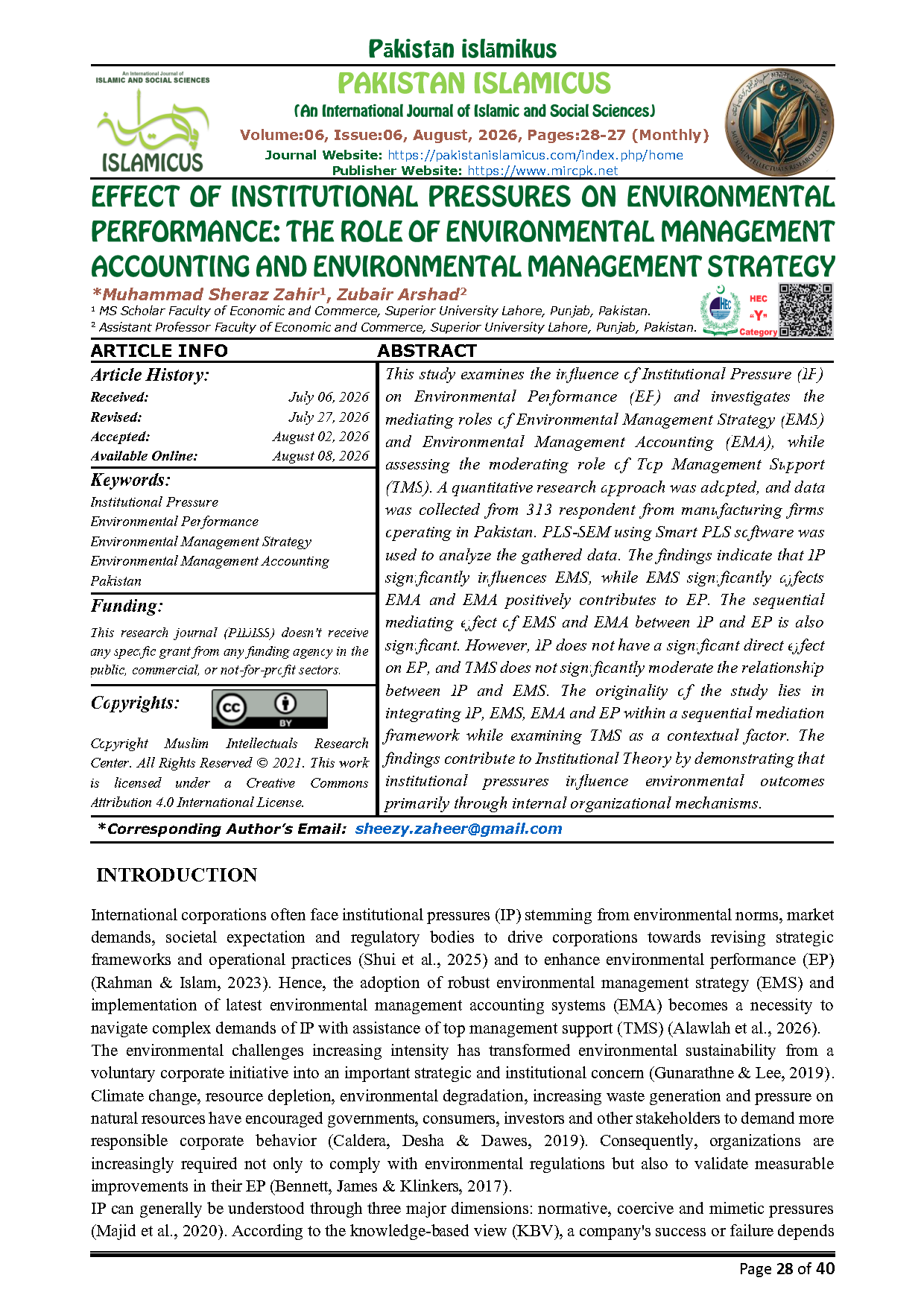
EFFECT OF INSTITUTIONAL PRESSURES ON ENVIRONMENTAL PERFORMANCE: THE ROLE OF ENVIRONMENTAL MANAGEMENT ACCOUNTING AND ENVIRONMENTAL MANAGEMENT STRATEGY
Keywords:
Institutional Pressure; Environmental Performance; Environmental Management Strategy; Environmental Management Accounting; Pakistan.Abstract
This study examines the influence of Institutional Pressure (IP) on Environmental Performance (EP) and investigates the mediating roles of Environmental Management Strategy (EMS) and Environmental Management Accounting (EMA), while assessing the moderating role of Top Management Support (TMS). A quantitative research approach was adopted, and data was collected from 313 respondent from manufacturing firms operating in Pakistan. PLS-SEM using Smart PLS software was used to analyze the gathered data. The findings indicate that IP significantly influences EMS, while EMS significantly affects EMA and EMA positively contributes to EP. The sequential mediating effect of EMS and EMA between IP and EP is also significant. However, IP does not have a significant direct effect on EP, and TMS does not significantly moderate the relationship between IP and EMS. The originality of the study lies in integrating IP, EMS, EMA and EP within a sequential mediation framework while examining TMS as a contextual factor. The findings contribute to Institutional Theory by demonstrating that institutional pressures influence environmental outcomes primarily through internal organizational mechanisms.
Downloads
References
Alawlah, A., A’aqoulah, A., Alamr, R., & El-Metwally, A. (2026). Prevalence and risk factors of falls among the older adults in Gulf Cooperation Council countries: insights from a systematic review. BMC Public Health, 26(1), 600.
Alnaim, M., & Metwally, A. B. M. (2024). Institutional pressures and environmental management accounting adoption: Do environmental strategy matter?. Sustainability, 16(7), 3020.
Arda, O. A., Bayraktar, E., & Tatoglu, E. (2019). How do integrated quality and environmental management practices affect firm performance? Mediating roles of quality performance and environmental proactivity. Business strategy and the environment, 28(1), 64-78.
Asiaei, K., Barani, O., Rezaee, Z., Bontis, N., & Najaf, K. (2025, December). Leveraging environmental management accounting and green ambidexterity for competitive advantage: a natural resource orchestration view. In Accounting Forum (pp. 1-25). Routledge.
Bennett, M., James, P., & Klinkers, L. (Eds.). (2017). Sustainable measures: Evaluation and reporting of environmental and social performance. Routledge.
Bresciani, S., Rehman, S. U., Giovando, G., & Alam, G. M. (2023). The role of environmental management accounting and environmental knowledge management practices influence on environmental performance: mediated-moderated model. Journal of knowledge management, 27(4), 896-918.
Bresciani, S., Rehman, S. U., Giovando, G., & Alam, G. M. (2023). The role of environmental management accounting and environmental knowledge management practices influence on environmental performance: mediated-moderated model. Journal of knowledge management, 27(4), 896-918.
Burritt, R. L., & Saka, C. (2006). Environmental management accounting applications and eco-efficiency: Case studies of emission reduction in Japanese companies. Journal of Cleaner Production, 14(14), 1262–1275.
Burritt, R. L., Hahn, T., & Schaltegger, S. (2002). Towards a comprehensive framework for environmental management accounting—Links between business actors and environmental management accounting tools. Australian Accounting Review, 12(27), 39–50.
Caldera, H. T. S., Desha, C., & Dawes, L. (2019). Evaluating the enablers and barriers for successful implementation of sustainable business practice in ‘lean’SMEs. Journal of cleaner production, 218, 575-590.
Chaudhry, N. I., Asad, H., & Hussain, R. I. (2020). From institutional pressure to the sustainable development of firm: Role of environmental management accounting implementation and environmental proactivity. Business Strategy and the Environment, 29(8), 3542–3554.
Christ, K. L., & Burritt, R. L. (2021). Accounting for modern slavery risk in the time of COVID-19: challenges and opportunities. Accounting, Auditing & Accountability Journal, 34(6), 1484-1501.
Coglianese, C., & Lazer, D. (2003). Management-based regulation: Prescribing private management to achieve public goals. Law & Society Review, 37(4), 691-730.
Dieste, M., Panizzolo, R., Garza-Reyes, J. A., & Anosike, A. (2019). The relationship between lean and environmental performance: Practices and measures. Journal of Cleaner Production, 224, 120-131.
DiMaggio, P. J., & Powell, W. W. (1983). The iron cage revisited: Institutional isomorphism and collective rationality in organizational fields. American Sociological Review, 48(2), 147–160.
Elhossade, S. S., Abdo, H., & Mas’ ud, A. (2021). Impact of institutional and contingent factors on adopting environmental management accounting systems: the case of manufacturing companies in Libya. Journal of Financial Reporting and Accounting, 19(4), 497-539.
Farag, M. I. H. (2026). Sustainability as a management strategy: Integrating environmental, social, and governance practices into business administration. Management Science Advances, 3(1), 20-44.
Fiorini, P. C., Jabbour, C. J. C., Latan, H., de Sousa Jabbour, A. B. L., & Mariano, E. B. (2022). Green emerging digital technologies, green supply chains, and the performance of environmentally friendly firms: the underpinning role of human resources. IEEE Transactions on Engineering Management, 71, 13134-13148.
Gottschalk, P., & Hamerton, C. (2024). The emergent role of normative social pressure. In Corporate Crisis Recovery: Managing Organizational Deviance, Reputation, and Risk (pp. 239-263). Cham: Springer Nature Switzerland.
Gunarathne, A. N., & Lee, K. H. (2019). Environmental and managerial information for cleaner production strategies: An environmental management development perspective. Journal of Cleaner Production, 237, 117849.
Hasan, S. A. S., Waghule, S. N., & Hasan, M. B. (2024). Linking environmental management accounting to environmental performance: The role of top management support and institutional pressures. Cogent Business & Management, 11(1), 2296700.
Huynh, H. T. N., Nguyen, N. T. T., & Vo, N. N. Y. (2024). The influence of knowledge management, green transformational leadership, green organizational culture on green innovation and sustainable performance: The case of Vietnam. Journal of Open Innovation: Technology, Market, and Complexity, 10(4), 100436.
Imtiaz Ferdous, M., Adams, C. A., & Boyce, G. (2019). Institutional drivers of environmental management accounting adoption in public sector water organisations. Accounting, Auditing & Accountability Journal, 32(4), 984-1012.
Jalaludin, D., Sulaiman, M., & Nazli Nik Ahmad, N. (2011). Understanding environmental management accounting (EMA) adoption: a new institutional sociology perspective. Social Responsibility Journal, 7(4), 540-557.
Jasch, C. (2003). The use of Environmental Management Accounting (EMA) for identifying environmental costs. Journal of Cleaner production, 11(6), 667-676.
Journeault, M. (2016). The influence of the eco-control package on environmental and economic performance: A natural resource-based approach. Journal of Management Accounting Research, 28(2), 149-178.
Khalili, N.R. and Duecker, S., 2013. Application of multi-criteria decision analysis in design of sustainable environmental management system framework. Journal of Cleaner Production, 47, pp.188-198.
Khan, O., & Patala, S. (2026). Circular Economy Implementation: A Paradox–Dynamic Capabilities Perspective Under Institutional Pressures. Business Strategy and the Environment, e71551.
Khurshid, A., Hanif, M. S., Sajid, A., & Zaki, W. (2025). Highlighting the leadership role of top management and business strategy between institutional pressures and the adoption of environmental management accounting. International Journal of Organizational Leadership, 14, 70–88.
Kong, Y., Javed, F., Sultan, J., Hanif, M.S. and Khan, N., 2022. EMA implementation and corporate environmental firm performance: a comparison of institutional pressures and environmental uncertainty. Sustainability, 14(9), p.5662.
Laosirihongthong, T., Adebanjo, D., & Choon Tan, K. (2013). Green supply chain management practices and performance. Industrial Management & Data Systems, 113(8), 1088-1109.
Latan, H., Jabbour, C. J. C., de Sousa Jabbour, A. B. L., Wamba, S. F., & Shahbaz, M. (2018). Effects of environmental strategy, environmental uncertainty and top management's commitment on corporate environmental performance: The role of environmental management accounting. Journal of cleaner production, 180, 297-306.
Majid, A., Yasir, M., Yasir, M., & Javed, A. (2020). Nexus of institutional pressures, environmentally friendly business strategies, and environmental performance. Corporate Social Responsibility and Environmental Management, 27(2), 706-716.
Peltokorpi, V., & Hasu, M. (2016). Transactive memory systems in research team innovation: A moderated mediation analysis. Journal of Engineering and Technology Management, 39, 1-12.
Phan, T. N., & Baird, K. (2015). The comprehensiveness of environmental management systems: The influence of institutional pressures and the impact on environmental performance. Journal of environmental management, 160, 45-56.
Rahman, M. M., & Islam, M. E. (2023). The impact of green accounting on environmental performance: mediating effects of energy efficiency. Environmental Science and Pollution Research, 30(26), 69431-69452.
Reitzig, M., & Puranam, P. (2009). Value appropriation as an organizational capability: The case of IP protection through patents. Strategic management journal, 30(7), 765-789.
Schaltegger, S., Bennett, M., Burritt, R. L., & Jasch, C. (2008). Environmental management accounting (EMA) as a support for cleaner production. In Environmental management accounting for cleaner production (pp. 3-26). Dordrecht: Springer Netherlands.
Scott, W. R. (2008). Institutions and organizations: Ideas and interests (3rd ed.). Sage.
Shui, X., Zhang, M., Wang, Y., & Smart, P. (2025). Do climate change regulatory pressures increase corporate environmental sustainability performance? The moderating roles of foreign market exposure and industry carbon intensity. British Journal of Management, 36(1), 223-239.
Steger, U. (2000). Environmental management systems: empirical evidence and further perspectives. European management journal, 18(1), 23-37.
Swalih, M. M., Ram, R., & Tew, E. (2024). Environmental management accounting for strategic decision‐making: A systematic literature review. Business Strategy and the Environment, 33(7), 6335-6367.
Tang, C. S., & Zhou, S. (2022). Research advances in environmentally and socially sustainable operations. European Journal of Operational Research, 223(3), 585-594.
Tashakor, S., Appuhami, R., & Munir, R. (2019). Environmental management accounting practices in Australian cotton farming: The use of the theory of planned behaviour. Accounting, Auditing & Accountability Journal, 32(4), 1175-1202.
Tseng, C.H., Chang, K.H. and Chen, H.W., 2021. Strategic orientation, environmental management systems, and eco-innovation: Investigating the moderating effects of absorptive capacity. Sustainability, 13(21), p.12147.
Wang, S., Wang, H., & Wang, J. (2019). Exploring the effects of institutional pressures on the implementation of environmental management accounting: Do top management support and perceived benefit work? Business Strategy and the Environment, 28(1), 233–243.
Wijethilake, C. (2017). Proactive sustainability strategy and corporate sustainability performance: The mediating effect of sustainability control systems. Journal of environmental management, 196, 569-582.
Wiredu, J., Yang, Q., Sampene, A. K., Gyamfi, B. A., & Asongu, S. A. (2024). The effect of green supply chain management practices on corporate environmental performance: Does supply chain competitive advantage matter?. Business Strategy and the Environment, 33(3), 2578-2599.
Yuning, M., Taozhen, H., Saleem, N., & Hassan, A. H. (2024). Institutional pressure and low carbon innovation policy: the role of EMS, environmental interpretations and governance heterogeneity. Frontiers in Environmental Science, 12, 1385062.
Downloads
Published
Issue
Section
License
Copyright (c) 2026 PAKISTAN ISLAMICUS (An International Journal of Islamic & Social Sciences)

This work is licensed under a Creative Commons Attribution 4.0 International License.
This work is licensed under a Creative Commons Attribution 4.0 International License.