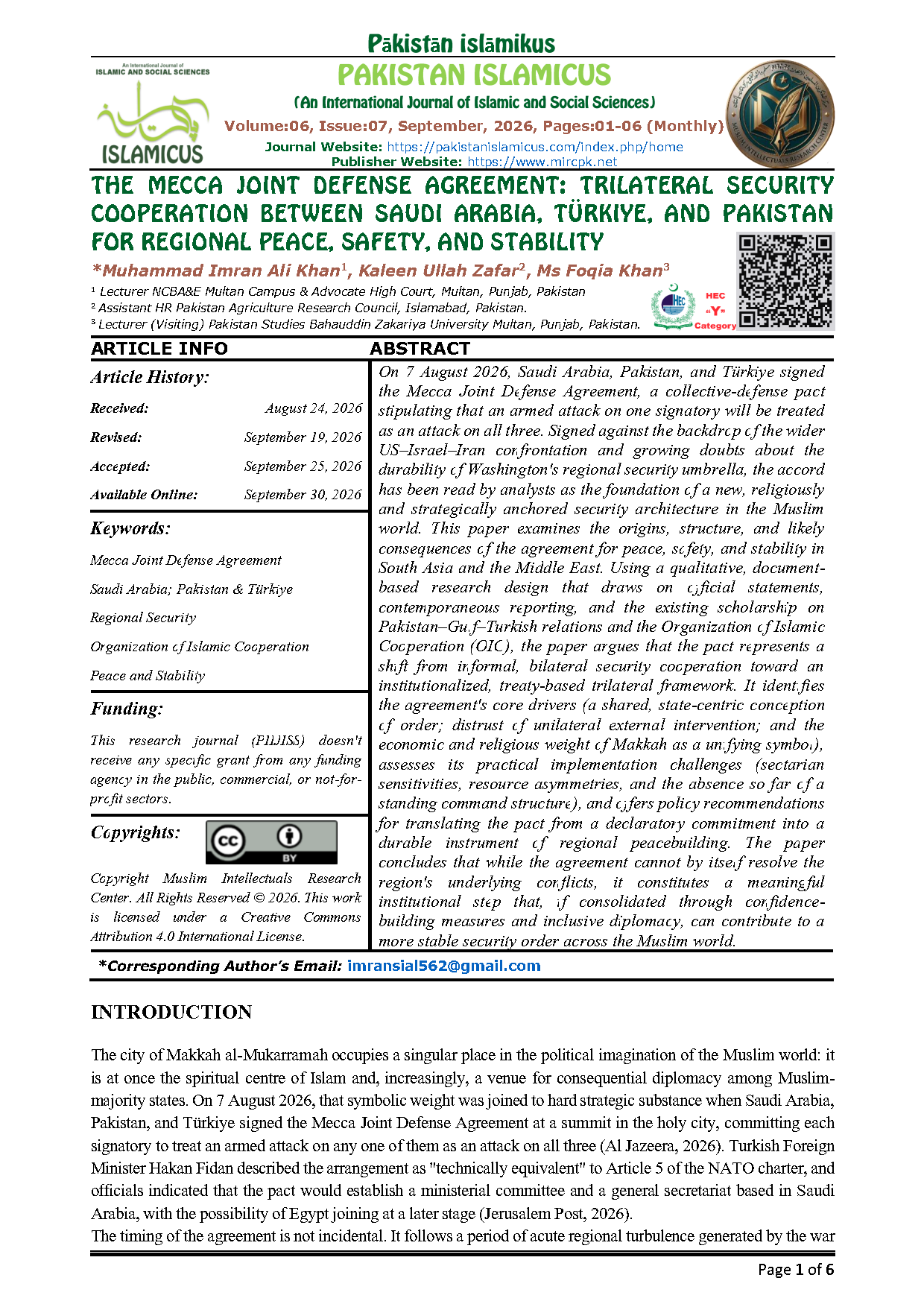
THE MECCA JOINT DEFENSE AGREEMENT: TRILATERAL SECURITY COOPERATION BETWEEN SAUDI ARABIA, TÜRKIYE, AND PAKISTAN FOR REGIONAL PEACE, SAFETY, AND STABILITY
Keywords:
Mecca Joint Defense Agreement; Saudi Arabia; Pakistan & Türkiye; Regional Security; Organization of Islamic Cooperation; Peace and Stability.Abstract
On 7 August 2026, Saudi Arabia, Pakistan, and Türkiye signed the Mecca Joint Defense Agreement, a collective-defense pact stipulating that an armed attack on one signatory will be treated as an attack on all three. Signed against the backdrop of the wider US–Israel–Iran confrontation and growing doubts about the durability of Washington's regional security umbrella, the accord has been read by analysts as the foundation of a new, religiously and strategically anchored security architecture in the Muslim world. This paper examines the origins, structure, and likely consequences of the agreement for peace, safety, and stability in South Asia and the Middle East. Using a qualitative, document-based research design that draws on official statements, contemporaneous reporting, and the existing scholarship on Pakistan–Gulf–Turkish relations and the Organization of Islamic Cooperation (OIC), the paper argues that the pact represents a shift from informal, bilateral security cooperation toward an institutionalized, treaty-based trilateral framework. It identifies the agreement's core drivers (a shared, state-centric conception of order; distrust of unilateral external intervention; and the economic and religious weight of Makkah as a unifying symbol), assesses its practical implementation challenges (sectarian sensitivities, resource asymmetries, and the absence so far of a standing command structure), and offers policy recommendations for translating the pact from a declaratory commitment into a durable instrument of regional peacebuilding. The paper concludes that while the agreement cannot by itself resolve the region's underlying conflicts, it constitutes a meaningful institutional step that, if consolidated through confidence-building measures and inclusive diplomacy, can contribute to a more stable security order across the Muslim world.
Downloads
References
Ahmed, Z. S., & Akbarzadeh, S. (2023). Pakistan, Pan-Islamism, and the organization of Islamic cooperation. Religions, 14(3), 289.
Jafaar, B. (2026). Deciphering the Middle East in a Multipolar Era: A Mixture of Cooperation and Competition Between Regional Players. In Middle East Geopolitics and the Rise of Multipolarity: Global Turning Point (pp. 111-147). Cham: Springer Nature Switzerland.
Jafaar, B. (2026). Deciphering the Middle East in a Multipolar Era: A Mixture of Cooperation and Competition Between Regional Players. In Middle East Geopolitics and the Rise of Multipolarity: Global Turning Point (pp. 111-147). Cham: Springer Nature Switzerland..
Schiavi, F. S. (2026). Building Strategic Resilience: How the Iran War is Reshaping Gulf Security. Confluences Méditerranée, 136(2), 71-86.Global Research / InfoBrics. (2026, August). "Islamic NATO" emerges as Saudi Arabia, Turkey and Pakistan forge new security axis.
Jafaar, B. (2026). Deciphering the Middle East in a Multipolar Era: A Mixture of Cooperation and Competition Between Regional Players. In Middle East Geopolitics and the Rise of Multipolarity: Global Turning Point (pp. 111-147). Cham: Springer Nature Switzerland.Middle East Eye. (2026, August). What Pakistan's defence pact with Saudi Arabia and Turkey means for the Middle East.
Mustafa, G., & Bano, N. (2020). The Organization of Islamic Cooperation (OIC): Challenges for the Islamic World. Journal of Development and Social Sciences, 1(1), 1-11.
Chaziza, M., & Lutmar, C. (2025). China's Strategic Engagement in the Middle East: Energy Security, Economic Integration, and Geopolitical Influence. asia policy, 20(3), 95-116.
Magray, M. I., Shaheen, S., & Shaheen, N. (2026). US Iran Strategic Rivalry and Its Impact on Middle East Regional Security Architecture. Social Science Review Archives, 4(1), 4317-4324.
Jafaar, B. (2026). Deciphering the Middle East in a Multipolar Era: A Mixture of Cooperation and Competition Between Regional Players. In Middle East Geopolitics and the Rise of Multipolarity: Global Turning Point (pp. 111-147). Cham: Springer Nature Switzerland.
Unnamed author. (2017). Islamic Military Alliance against terrorism: Efficacy and challenges. Academia.edu working paper.
Unnamed author(s). (2026). The alliance-building dilemma under shared security pressures in the context of the Greater Middle East project: Turkey, Iran, Pakistan, Saudi Arabia, and Egypt. ResearchGate working paper.
Kayaoglu, T. (2015). The Organization of Islamic Cooperation: Politics, problems, and potential. Routledge.
Downloads
Published
Issue
Section
License
Copyright (c) 2026 PAKISTAN ISLAMICUS (An International Journal of Islamic & Social Sciences)

This work is licensed under a Creative Commons Attribution 4.0 International License.
This work is licensed under a Creative Commons Attribution 4.0 International License.